 Add to Chrome
 Add to Firefox
 Add to Edge
AMix-2: Establishing Protein as a Native Modality in Large Language Models
May 29, 2026
We present AMix-2, a protein-text foundation model that establishes protein as a native modality in large language models (LLMs), unifying protein understanding and sequence design within a single foundation model. AMix-2 is built upon two key ideas: (1) a unified protein-text formulation that embeds natural language and protein sequence in a shared token space, enabling one model to perform biological reasoning and conditional design instead of separate downstream task-specialized models; and (2) a block-wise diffusion language modeling backbone that combines causal generation across blocks with bidirectional context and iterative refinement within blocks. This scheme better matches the intrinsic nature of proteins than a strict left-to-right factorization. To evaluate protein foundation models under realistic generalization settings, we further introduce ProteinArena, a comprehensive benchmark with time-aware and homology-aware protocols across various understanding and design tasks, and with baselines covering classical bioinformatics tools, protein-specialized models and LLMs. On ProteinArena, AMix-2 outperforms frontier LLMs and demonstrates competitive performance to task-specific protein models. Controlled experiments further show that the diffusion-based paradigm generally surpasses its autoregressive counterpart, highlighting the advantage of flexible generation order for protein sequences. We release both AMix-2 and ProteinArena to facilitate open research in protein foundation models.

Fix the Loss, Not the Radius: Rethinking the Adversarial Perturbation of Sharpness-Aware Minimization
May 11, 2026Sharpness-Aware Minimization (SAM) improves generalization by minimizing the worst-case loss within a fixed parameter-space radius neighborhood. SAM and its variants mainly rely on a first-order linearized surrogate, while flat minima are inherently a second-order (curvature) notion.We revisit this mismatch and propose Loss-Equated SAM (LE-SAM), which inverts the traditional SAM mechanism that fixed perturbation radius with a fixed loss-space budget,effectively removing gradient-norm-dominated learning signals and shifting optimization toward curvature-dominated terms. Extensive experiments across diverse benchmarks and tasks demonstrate the strong generalization ability of LESAM that consistently outperforms SAM and even its variants, achieving the state-of-the-art performance.
Rethinking Loss Reweighting for Imbalance Learning as an Inverse Problem: A Neural Collapse Point of View
May 11, 2026Loss reweighting is a widely used strategy for long-tailed classification, but existing reweighting strategies often rely on heuristics and rarely define a well-specified target. Inspired by Neural Collapse (NC), the ideal simplex Equiangular Tight Frame (ETF) terminal geometry suggests equal per-class average loss as a reasonable target for reweighting. Based on the ideal equal loss objective, we consider loss reweighting as an inverse problem and propose an inverse-view reweighting strategy that infers class weights dynamically to match this ideal objective. Empirically, NC metrics suggest our method can effectively reduce the loss imbalance coefficient and closer alignment with NC geometry while consistently outperforming strong long-tailed baselines on different datasets.
Structured Prompting and LLM Ensembling for Multimodal Conversational Aspect-based Sentiment Analysis
Dec 27, 2025Understanding sentiment in multimodal conversations is a complex yet crucial challenge toward building emotionally intelligent AI systems. The Multimodal Conversational Aspect-based Sentiment Analysis (MCABSA) Challenge invited participants to tackle two demanding subtasks: (1) extracting a comprehensive sentiment sextuple, including holder, target, aspect, opinion, sentiment, and rationale from multi-speaker dialogues, and (2) detecting sentiment flipping, which detects dynamic sentiment shifts and their underlying triggers. For Subtask-I, in the present paper, we designed a structured prompting pipeline that guided large language models (LLMs) to sequentially extract sentiment components with refined contextual understanding. For Subtask-II, we further leveraged the complementary strengths of three LLMs through ensembling to robustly identify sentiment transitions and their triggers. Our system achieved a 47.38% average score on Subtask-I and a 74.12% exact match F1 on Subtask-II, showing the effectiveness of step-wise refinement and ensemble strategies in rich, multimodal sentiment analysis tasks.
Reflection Pretraining Enables Token-Level Self-Correction in Biological Sequence Models
Dec 24, 2025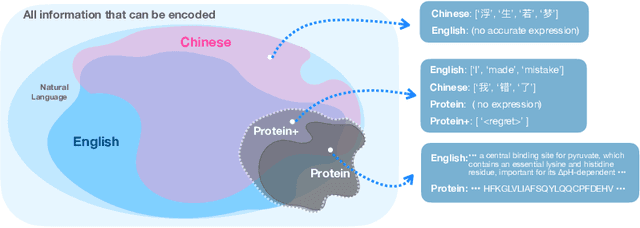
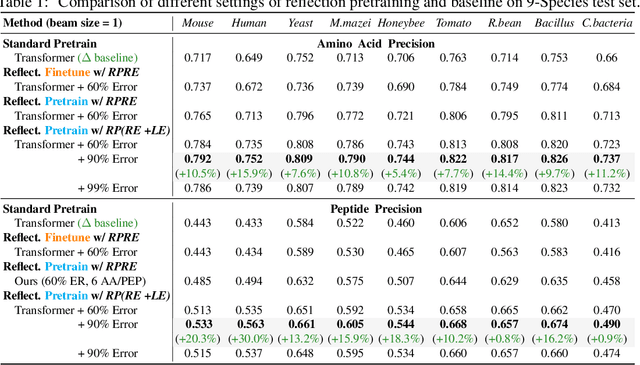
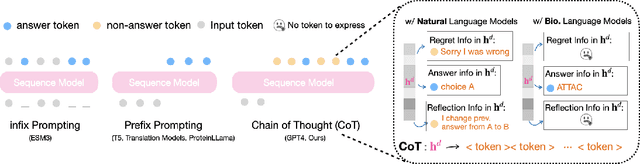
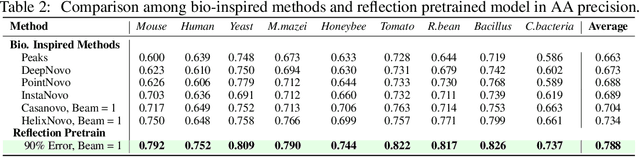
Chain-of-Thought (CoT) prompting has significantly advanced task-solving capabilities in natural language processing with large language models. Unlike standard prompting, CoT encourages the model to generate intermediate reasoning steps, non-answer tokens, that help guide the model toward more accurate final outputs. These intermediate steps enable more complex reasoning processes such as error correction, memory management, future planning, and self-reflection. However, applying CoT to non-natural language domains, such as protein and RNA language models, is not yet possible, primarily due to the limited expressiveness of their token spaces (e.g., amino acid tokens). In this work, we propose and define the concept of language expressiveness: the ability of a given language, using its tokens and grammar, to encode information. We show that the limited expressiveness of protein language severely restricts the applicability of CoT-style reasoning. To overcome this, we introduce reflection pretraining, for the first time in a biological sequence model, which enables the model to engage in intermediate reasoning through the generation of auxiliary "thinking tokens" beyond simple answer tokens. Theoretically, we demonstrate that our augmented token set significantly enhances biological language expressiveness, thereby improving the overall reasoning capacity of the model. Experimentally, our pretraining approach teaches protein models to self-correct and leads to substantial performance gains compared to standard pretraining.
Probing Scientific General Intelligence of LLMs with Scientist-Aligned Workflows
Dec 18, 2025Despite advances in scientific AI, a coherent framework for Scientific General Intelligence (SGI)-the ability to autonomously conceive, investigate, and reason across scientific domains-remains lacking. We present an operational SGI definition grounded in the Practical Inquiry Model (PIM: Deliberation, Conception, Action, Perception) and operationalize it via four scientist-aligned tasks: deep research, idea generation, dry/wet experiments, and experimental reasoning. SGI-Bench comprises over 1,000 expert-curated, cross-disciplinary samples inspired by Science's 125 Big Questions, enabling systematic evaluation of state-of-the-art LLMs. Results reveal gaps: low exact match (10--20%) in deep research despite step-level alignment; ideas lacking feasibility and detail; high code executability but low execution result accuracy in dry experiments; low sequence fidelity in wet protocols; and persistent multimodal comparative-reasoning challenges. We further introduce Test-Time Reinforcement Learning (TTRL), which optimizes retrieval-augmented novelty rewards at inference, enhancing hypothesis novelty without reference answer. Together, our PIM-grounded definition, workflow-centric benchmark, and empirical insights establish a foundation for AI systems that genuinely participate in scientific discovery.
Accurate de novo sequencing of the modified proteome with OmniNovo
Dec 13, 2025Post-translational modifications (PTMs) serve as a dynamic chemical language regulating protein function, yet current proteomic methods remain blind to a vast portion of the modified proteome. Standard database search algorithms suffer from a combinatorial explosion of search spaces, limiting the identification of uncharacterized or complex modifications. Here we introduce OmniNovo, a unified deep learning framework for reference-free sequencing of unmodified and modified peptides directly from tandem mass spectra. Unlike existing tools restricted to specific modification types, OmniNovo learns universal fragmentation rules to decipher diverse PTMs within a single coherent model. By integrating a mass-constrained decoding algorithm with rigorous false discovery rate estimation, OmniNovo achieves state-of-the-art accuracy, identifying 51\% more peptides than standard approaches at a 1\% false discovery rate. Crucially, the model generalizes to biological sites unseen during training, illuminating the dark matter of the proteome and enabling unbiased comprehensive analysis of cellular regulation.
Plan Then Action:High-Level Planning Guidance Reinforcement Learning for LLM Reasoning
Oct 02, 2025Large language models (LLMs) have demonstrated remarkable reasoning abilities in complex tasks, often relying on Chain-of-Thought (CoT) reasoning. However, due to their autoregressive token-level generation, the reasoning process is largely constrained to local decision-making and lacks global planning. This limitation frequently results in redundant, incoherent, or inaccurate reasoning, which significantly degrades overall performance. Existing approaches, such as tree-based algorithms and reinforcement learning (RL), attempt to address this issue but suffer from high computational costs and often fail to produce optimal reasoning trajectories. To tackle this challenge, we propose Plan-Then-Action Enhanced Reasoning with Group Relative Policy Optimization PTA-GRPO, a two-stage framework designed to improve both high-level planning and fine-grained CoT reasoning. In the first stage, we leverage advanced LLMs to distill CoT into compact high-level guidance, which is then used for supervised fine-tuning (SFT). In the second stage, we introduce a guidance-aware RL method that jointly optimizes the final output and the quality of high-level guidance, thereby enhancing reasoning effectiveness. We conduct extensive experiments on multiple mathematical reasoning benchmarks, including MATH, AIME2024, AIME2025, and AMC, across diverse base models such as Qwen2.5-7B-Instruct, Qwen3-8B, Qwen3-14B, and LLaMA3.2-3B. Experimental results demonstrate that PTA-GRPO consistently achieves stable and significant improvements across different models and tasks, validating its effectiveness and generalization.
Curriculum Learning for Biological Sequence Prediction: The Case of De Novo Peptide Sequencing
Jun 16, 2025Peptide sequencing-the process of identifying amino acid sequences from mass spectrometry data-is a fundamental task in proteomics. Non-Autoregressive Transformers (NATs) have proven highly effective for this task, outperforming traditional methods. Unlike autoregressive models, which generate tokens sequentially, NATs predict all positions simultaneously, leveraging bidirectional context through unmasked self-attention. However, existing NAT approaches often rely on Connectionist Temporal Classification (CTC) loss, which presents significant optimization challenges due to CTC's complexity and increases the risk of training failures. To address these issues, we propose an improved non-autoregressive peptide sequencing model that incorporates a structured protein sequence curriculum learning strategy. This approach adjusts protein's learning difficulty based on the model's estimated protein generational capabilities through a sampling process, progressively learning peptide generation from simple to complex sequences. Additionally, we introduce a self-refining inference-time module that iteratively enhances predictions using learned NAT token embeddings, improving sequence accuracy at a fine-grained level. Our curriculum learning strategy reduces NAT training failures frequency by more than 90% based on sampled training over various data distributions. Evaluations on nine benchmark species demonstrate that our approach outperforms all previous methods across multiple metrics and species.
PhySense: Principle-Based Physics Reasoning Benchmarking for Large Language Models
May 30, 2025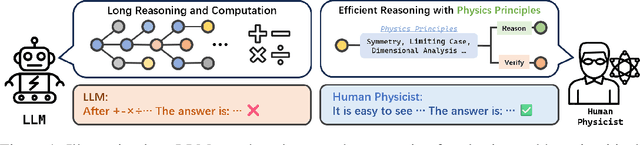
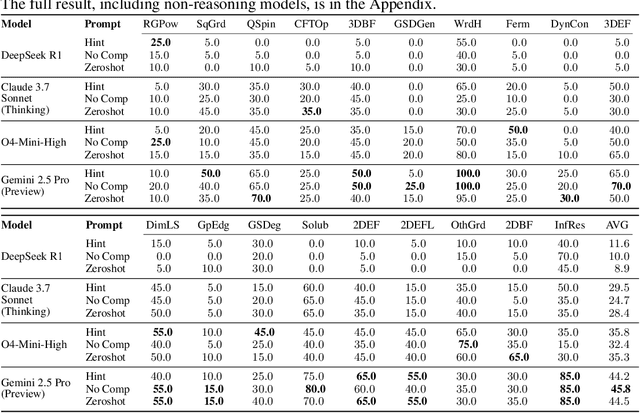

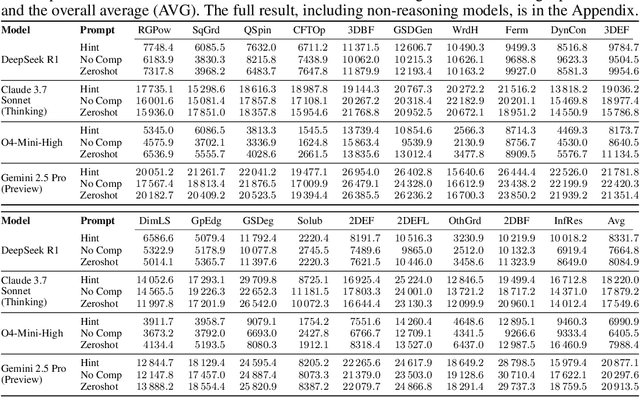
Large language models (LLMs) have rapidly advanced and are increasingly capable of tackling complex scientific problems, including those in physics. Despite this progress, current LLMs often fail to emulate the concise, principle-based reasoning characteristic of human experts, instead generating lengthy and opaque solutions. This discrepancy highlights a crucial gap in their ability to apply core physical principles for efficient and interpretable problem solving. To systematically investigate this limitation, we introduce PhySense, a novel principle-based physics reasoning benchmark designed to be easily solvable by experts using guiding principles, yet deceptively difficult for LLMs without principle-first reasoning. Our evaluation across multiple state-of-the-art LLMs and prompt types reveals a consistent failure to align with expert-like reasoning paths, providing insights for developing AI systems with efficient, robust and interpretable principle-based scientific reasoning.